
Why Investing in Home Charging Infrastructure Matters in 2026
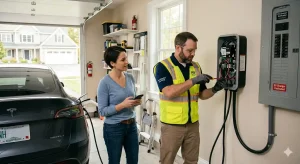
The transition to electric mobility has reached a definitive tipping point in 2026. As more manufacturers phase out internal combustion engines, having a dedicated EV Charger Installation at your residence is no longer just a luxury, it is a fundamental upgrade to your home’s utility and value. Relying on public charging networks can be time-consuming and inconsistent, whereas home charging offers the ultimate convenience of waking up to a “full tank” every single morning.
For homeowners in the Northeast, particularly those looking for an EV Charger Installation, understanding the technical requirements is essential. This guide is designed to demystify the process, from evaluating your current electrical panel capacity to choosing the right hardware for your specific vehicle and driving habits. We want to ensure you have the deep technical knowledge needed to make an informed decision for your property.
Modern electric vehicle supply equipment, or EVSE, has become significantly more intelligent over the last few years. In 2026, we are seeing units that integrate seamlessly with home solar arrays and battery storage systems, allowing you to optimize your energy consumption and reduce your carbon footprint. By planning your installation correctly today, you are future-proofing your home for the next generation of automotive technology.
Decoding the Different Levels of Electric Vehicle Charging
When you start researching how to power your new electric car, the first thing you will encounter is the distinction between charging levels. It is vital to understand these differences because they dictate how quickly your battery replenishes and what kind of electrical work is required. Most vehicles come with a basic cord, but for a true high-speed experience, a more robust setup is necessary.
Level 1 charging is essentially plugging your car into a standard 120-volt household outlet. While it requires no special equipment, it is incredibly slow, often providing only 3 to 5 miles of range per hour of charging. This might work for someone with a very short commute, but for most modern EVs with large battery packs, it is simply impractical as a primary solution.
Level 2 charging is the gold standard for residential applications in 2026. These systems operate on a 240-volt circuit, similar to what a clothes dryer or electric oven uses. A Level 2 station can fully charge most vehicles overnight, providing roughly 25 to 40 miles of range per hour. This level of efficiency requires a dedicated circuit and professional installation to ensure safety and compliance with the National Electrical Code.
Assessing Your Home Electrical Panel Capacity
Before purchasing a charging station, you must determine if your home’s electrical infrastructure can handle the additional load. A standard Level 2 charger typically requires a 40-amp to 60-amp circuit. If your home currently has a 100-amp service, you might be nearing your limit, especially if you run other heavy appliances like air conditioners, electric ranges, or hot tubs simultaneously.
An experienced Electrical Contractor will perform a load calculation to see how much “headroom” your panel has. In many older homes across New England, a service upgrade to 200 amps is a prerequisite for a safe installation. This ensures that adding an EV load won’t cause frequent breaker trips or, worse, overheat your electrical components.
Panel Age: Older panels may have degraded bus bars or outdated breaker designs that aren’t suited for continuous high-draw loads.
Available Spaces: You will need two adjacent slots in your breaker panel to install the double-pole breaker required for 240-volt charging.
Sub-panels: If your garage is far from the main house, installing a sub-panel might be the most efficient way to manage the wiring for your EVSE.
Choosing the Right EVSE Hardware for 2026
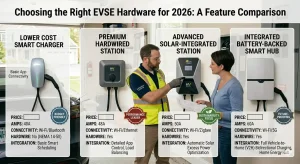
The market for charging stations has exploded with options, ranging from basic “plug-and-play” models to sophisticated smart chargers. When selecting your hardware, consider whether you want a hardwired unit or one that plugs into a NEMA 14-50 outlet. Hardwired units are generally considered more reliable for outdoor installations and can often support higher amperages, such as 48 or 50 amps.
Smart chargers offer several advantages in the current energy landscape. They allow you to monitor your energy usage via smartphone apps, set charging schedules to take advantage of off-peak utility rates, and even participate in demand-response programs. Some advanced models in 2026 even feature bi-directional charging capabilities, potentially allowing your car to power your home during an outage.
| Feature | Plug-in (NEMA 14-50) | Hardwired Connection |
| Max Amperage | Typically limited to 40A | Can support 48A to 80A |
| Portability | Can be removed and taken with you | Permanent installation |
| Installation Cost | Often lower if outlet exists | Requires dedicated wiring to unit |
| Weather Resistance | Moderate (outlet needs protection) | High (best for outdoor use) |
The Installation Process: What to Expect
Once you have selected your charger and confirmed your panel capacity, the actual installation involves several key steps. Your contractor will run a dedicated line of heavy-gauge wire from your electrical panel to the desired charging location, usually in the garage or on a driveway pedestal. The thickness of this wire is crucial, as thin wire can create resistance and heat under continuous load.
Safety is the paramount concern during this process. In 2026, building codes have become very specific about EVSE installations, including requirements for Ground Fault Circuit Interrupter (GFCI) protection in certain scenarios and specific mounting heights. After the wiring is pulled and the unit is mounted, a series of tests are conducted to ensure the pilot signal between the charger and the vehicle is functioning correctly.
In many jurisdictions, a permit is required for this work. This involves an inspection by a local building official to verify that the installation meets all safety standards. While this adds a step to the process, it provides peace of mind that your home and vehicle are protected from electrical faults.
Optimizing Charging for Longevity and Efficiency
Installing the charger is only half the battle, using it correctly is what ensures the long-term health of your vehicle’s battery. Most manufacturers recommend keeping your battery state-of-charge between 20% and 80% for daily use. Constantly charging to 100% or letting the battery drop to zero can accelerate degradation over time.
You should also take advantage of your charger’s scheduling features. In many parts of the country, electricity is significantly cheaper late at night when overall demand is low. By setting your car to start charging at midnight, you can save a substantial amount on your monthly energy bill while also reducing the strain on the regional power grid.
Environmental and Financial Benefits of Home Charging
Beyond the sheer convenience, home charging is a major win for both your wallet and the planet. When you compare the cost per mile of electricity versus gasoline, the savings are often 50% or more. Furthermore, as the grid integrates more renewable energy sources like wind and solar, the carbon footprint of your daily commute continues to shrink.
Many utility companies and local governments offer incentives to offset the cost of EV Charger Installation. These can come in the form of tax credits, direct rebates, or even free smart charging hardware. Be sure to check with your local provider before starting your project to see what programs are available in 2026.
Frequently Asked Questions About Residential EV Charging
Can I install an EV charger myself?
While it might be tempting to treat this as a DIY project, it is highly discouraged. Dealing with high-voltage electricity and continuous loads requires specialized knowledge and tools. A mistake in wire sizing or torque settings can lead to an electrical fire. Always hire a licensed professional.
How long does the installation take?
For a standard installation where the panel has enough capacity and the run to the garage is straightforward, the work can usually be completed in 4 to 6 hours. If a panel upgrade or extensive trenching is required, it may take a full day or more.
Does charging at home increase my fire risk?
When installed correctly by a professional using high-quality components, the risk is negligible. Modern EVSE units have multiple built-in safety features that automatically shut off power if any abnormality, such as a ground fault or overheating, is detected.
Local Regulations and Climate Considerations in the Northeast
In our region, weather plays a significant role in electrical performance. Cold winters can temporarily reduce battery efficiency, meaning you might need to charge more frequently. If your charger is installed outdoors, it must be rated for extreme weather and properly sealed against moisture and ice.
Furthermore, local towns have varying requirements for permitting. Whether you are looking for an ev charger installation in bedford nh or a project in Massachusetts, your contractor must be familiar with the specific amendments to the electrical code in that state. This local expertise ensures that your installation is not only functional but also fully compliant with all regional safety laws.
Conclusion and Future Outlook
The move toward electric vehicles is a journey toward a cleaner, more efficient future. By installing a high-quality charging station at home in 2026, you are taking a major step toward energy independence and modernizing your home’s infrastructure. The convenience of never visiting a gas station again is a life-changing experience that most EV owners wouldn’t trade for anything.
As technology continues to evolve, we expect to see even tighter integration between our vehicles and our homes. The investment you make today in a robust electrical system will serve as the backbone for these future innovations. Take the time to plan carefully, choose quality equipment, and always prioritize safety by working with experts who understand the nuances of high-voltage residential work.
If you are ready to make the switch and need a reliable partner to handle the technical details of your power needs, our team is standing by to provide the highest level of service and expertise in the industry.
To schedule a professional site assessment or to learn more about our services, contact High Voltage Electric today:
Find a Trusted EV Charger Installation Contractor Near You
Selecting the right professional for your electrical needs is crucial for the safety and efficiency of your home. A local team that understands regional electrical codes and climate challenges can ensure a seamless installation process from start to finish. High Voltage Electric provides specialized residential services across multiple communities, delivering high-performance charging solutions tailored to your specific vehicle and home layout.
If you are located in one of the areas below, explore our dedicated service pages to learn more about how we can help with your electric vehicle infrastructure:
- EV Charger Installation in Dover, MA
- EV Charger Installation in Windham, NH
- EV Charger Installation in Wellesley, MA
- EV Charger Installation in Hollis, NH
- EV Charger Installation in Bedford, NH
- EV Charger Installation in Nashua, NH
- EV Charger Installation in Bedford, MA
- EV Charger Installation in Brookline, MA
- EV Charger Installation in Brookline, NH
- EV Charger Installation in Weston, NH